
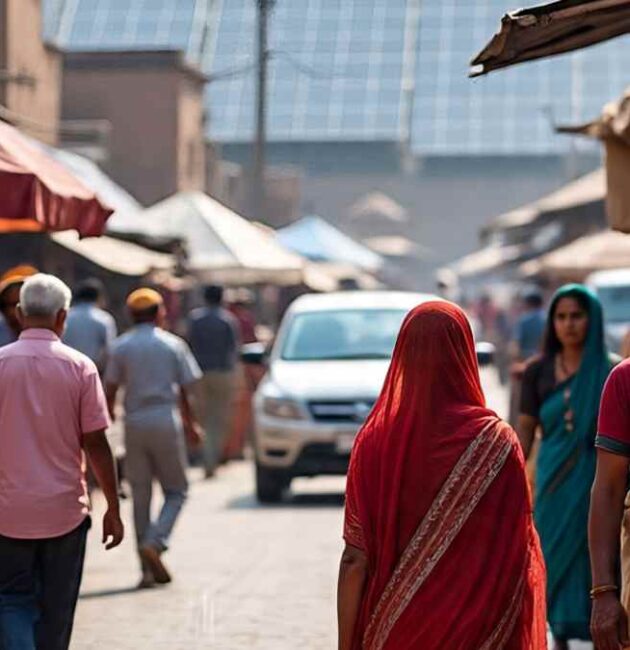
India’s electricity demand surged by 9% during the peak heatwave months of April–June 2024 compared to the same period in 2023, as record-breaking temperatures pushed the country deeper into a vicious cycle of heat, fossil fuel dependence, and escalating emissions, warns a new study.
As the nation grapples with intensifying heatwaves and unprecedented temperature rises, experts are calling for urgent investments in renewable energy storage and grid infrastructure to break free from this dangerous pattern that is simultaneously worsening climate change and straining public health systems.
India Records Hottest Year, 2024 Surpasses All Previous Records
India’s annual maximum temperatures increased steadily across most states from 0.1°C to 0.5°C during the last decade, with 2024 emerging as the hottest year on record. The year averaged +0.65°C above the 1991-2020 baseline, surpassing the previous 2016 record and aligning with the global temperature rise of 0.62 degrees celsius.
The Indo-Gangetic region witnessed persistent temperature rises, with summer peaks frequently exceeding 45°C. An unprecedented 52.3°C was recorded in Mungeshpur, Delhi, in 2024, marking intensified and prolonged heat waves that are becoming the new normal across the country.
According to the study Breaking the Cycle, which analyses decadal changes in temperatures, heatwaves, and their impact on electricity demand, these rising temperatures are no longer a standalone climate issue but an interconnected threat that amplifies stress on the power grid, worsens emissions, and challenges both infrastructure and public health systems simultaneously.
Northern and Himalayan Regions Bear the Brunt
The northern Indian states, including Delhi, Uttar Pradesh, Punjab, and Haryana, were identified as the most affected regions, exhibiting the sharpest increases in summer temperature surges. Central and Eastern states such as Madhya Pradesh, Jharkhand, and Chhattisgarh faced an average of 50 heatwave days every year between 2014 and 2024.
Most alarmingly, traditionally cooler regions such as Uttarakhand (11.2%) and Ladakh (9.1%) registered the highest percentage increases in annual summer temperatures, signalling expanding vulnerability in high-altitude areas. Uttarakhand had the most notable increase in heatwave days, jumping from 0 heatwave days in 2023 to 25 heatwave days in 2024, reflecting the growing reach of extreme heat into previously moderate regions.
Heatwaves Intensify and Spread Across India
The expansion and intensification of heatwaves has been dramatic. The number of days with temperatures ≥40°C rose sharply in the latter half of the decade, with 14 states recording a ≥15% increase in summer heat intensity between 2015 and 2024. This highlights that extreme heat events are becoming both more widespread and more severe across India.
The temperature-demand correlation is particularly stark in certain states. Uttar Pradesh recorded the strongest linkage between temperature and electricity consumption, with peak demand surging from approximately 14.2 GW in 2015 to 25.5 GW in 2024. Similar correlations were observed in Rajasthan and Delhi, where intense pre-monsoon heat consistently drove higher summer demand.
The Emissions Cost of Heat-Driven Power Demand
The increase in summertime temperatures added close to 9% to India’s power demand surge during the peak heatwave months of April-June 2024, resulting in emissions of 327 MtCO2. More concerning is the cumulative impact: the increase in fossil-based power consumption during summertime over the last 10 years resulted in 2.5 GtCO2 emissions, underscoring the massive climate challenge India faces as it meets growing cooling demand.
Dr. Manish Ram, CEO at Climate Compatible Futures, emphasized the urgency of the situation: “Our research shows that increase in temperatures across India has consistently increased electricity demand predominantly for cooling needs, resulting in further dependence on fossil fuels. Meeting the summer power demand surge with fossil fuels has led to more emissions and air pollution, exacerbating climate change and worsening health crisis. It’s important to break this cycle to avoid disproportionately impacting the financially disadvantaged and vulnerable sections of our society that bear the brunt of rising temperatures and heatwaves.”
The power demand surge due to high temperature and heatwaves has a disproportionate impact on rural regions compared to urban areas. The vulnerability of low-income populations to heat and energy access disruptions reflects existing socioeconomic disparities, with the most vulnerable bearing the heaviest burden.
Progress on Renewables, But Fossil Fuels Still Dominate
Despite the grim picture, there are signs of progress. India’s power system expanded significantly, growing from 285 GW in 2015 to 461 GW in 2024. Renewable energy more than doubled from 84 GW to 209 GW, while fossil-fuel capacity also rose from 195 GW to 243 GW.
While coal continues to be the base energy source, the rising share of renewable energy is slowly elbowing it out. RE generation saw an impressive 121% rise over the decade while fossil fuel generation rose by 50% during the same period. India’s growing deployment of climate policies across power, transport and residential sectors did ensure that up to 440 MtCO2 emissions were saved between 2015-2020, according to research.
However, recent studies by Ember and CREA show that much more can be done. Ember’s latest report highlights how meeting 2032 power capacity targets as outlined by India’s National Electricity Plan would eliminate the need to build more coal power plants beyond what is already under construction. CREA’s report highlights how coal power generation in India could peak and decline if India were to install 50 GW of annual renewable energy capacity until 2035.
Critical Gaps in Heat Action Plans
The report analyzed existing heat action plans across states, cities, and districts and found a critical policy gap. Only four states, three cities, and one district currently integrate renewable energy measures such as solar-powered systems or battery backups into their Heat Action Plans (HAPs), exposing significant weaknesses in linking climate adaptation with energy resilience.
Existing HAPs lack comprehensive integration of energy and electricity planning. Future frameworks must include renewable backup systems, demand forecasting models, and urban cooling strategies to enhance preparedness and energy resilience during heatwaves.
Urgent Call for Storage and Grid Investments
Aarti Khosla, Director of Climate Trends, warned: “The findings show that India’s heatwaves and power shortages can no longer be treated as separate crises. They are converging. It is clear that the only durable way out is to urgently upgrade our grid, invest in storage and enable flexible, climate-resilient electricity systems. Without these investments, every summer will lock us deeper into fossil dependence, negating the progress made on transition with higher emissions and worsening public health impacts. Breaking this cycle is not just a climate imperative — it is an equity imperative for millions of Indians who are the least responsible but the most vulnerable to extreme heat.”
The report emphasizes the urgent need for investments in storage solutions, flexible generation, resilient smart grids and demand-side management to increase the penetration of renewables across the country. States hit by heat-driven spikes in power demand must urgently expand renewable energy and storage capacities to reduce their dependence on fossil fuels.
Global Context: COP30 Delivers Mixed Results on Climate Action
While India grapples with its heat-energy crisis, the recently concluded COP30 climate summit in Belém offered mixed signals on global climate action. The Global Climate and Health Alliance expressed disappointment that the summit failed to deliver genuinely transformative outcomes, particularly on the phaseout of fossil fuels.
Dr. Jeni Miller, Executive Director of the Global Climate and Health Alliance, stated: “Belém promised to deliver a turning point in progress on addressing climate change, and a COP that put people and action at its centre, but while progress has been made on some important issues, COP30 has not delivered on that turning point.”
Adaptation Finance: Too Little, Too Late
On adaptation finance, COP30 agreed to triple adaptation finance by 2035, but pushed out the delivery date compared to the 2030 timeline requested by developing countries. “Pushing out the delivery date means many more people will suffer, many more people will die,” said Miller. “Every country is now experiencing the impacts of climate change in real time. Without timely and vital finance, as well as technical support and capacity building, developing countries are becoming overwhelmed by the growing impacts of the climate crisis.”
Developing countries, which have done little to cause the climate crisis and are grappling with poverty, struggling health systems, and fragile infrastructure, are far less equipped to prepare for and adapt to those impacts. For low-income developing countries, existing financial flows are difficult to access and have historically come with crippling interest rates creating an impossible debt burden that diverts domestic funds away from healthcare, education, and domestic infrastructure.
Fossil Fuel Phaseout: A Roadmap Without Clarity
During the plenary on November 22, Brazil’s COP30 President André Corrêa do Lago announced he would create two roadmaps—one on halting and reversing deforestation, and one on transitioning away from fossil fuels in a just, orderly and equitable manner. These will be led by science and will be inclusive, with a series of high-level dialogues and a report back to COP. However, Colombia’s proposal to include language in the mitigation decision about further work on just and equitable transition away from fossil fuels in 2026 was not incorporated into the text.
“Failure by governments at COP30 to agree to a phase out of fossil fuels not only increases the risk to people from climate impacts, but ensures that all countries will increasingly become overwhelmed,” continued Miller. “Without phasing out fossil fuels, the primary driver of climate change, impacts will continue to grow, we will experience dangerous and irreversible tipping points in critical earth systems. If we do not succeed in phasing out fossil fuels we will see healthcare systems collapse and widespread suffering.”
Just Transition: Progress on Framework, Questions on Implementation
In the final text of the just transition work programme, governments recognised the importance of protecting the human right to health and a clean, healthy and sustainable environment in just transitions, as well as the links between renewable energy and clean cooking. They also decided to establish a just transition mechanism to enhance international cooperation, technical assistance, capacity-building and knowledge sharing. However, resourcing will be necessary to operationalize this support to ensure health is not only recognised but actively protected and promoted through just transitions.
Health Community Voices Frustration
Health professionals from around the world expressed frustration at the lack of decisive action. Howard Catton, CEO of the International Council of Nurses, said: “Nurses carry the memories of patients whose suffering is tied to fossil fuels. We see the child gasping for air, the family grieving after climate disasters, and Indigenous communities losing health, land, and safety. These harms are not abstract. They deepen inequities and push health systems beyond their limits.”
Dr. Courtney Howard, Board Chair of the Global Climate and Health Alliance, shared her experience from the high Arctic: “In 2023 wildfires forced the evacuation of our hundred-bed hospital down to Vancouver. Smoke from these fires circled the planet, exposing 354 million people to increased air pollution leading to over 82,000 premature deaths globally. Given the current severity of impacts, it is clear that even in a high-income country we cannot adapt in a healthy way to the emissions trajectory we are on.”
Emily Bancroft from Health Care Without Harm US noted: “The lesson from COP30 is clear: you cannot have healthy people without a healthy planet. COP30 highlighted real progress, yet it also exposed the gaps we must confront: the political will to accelerate a just transition away from fossil fuels and inadequate financing to protect the most vulnerable.”
Gustavo H. N. Dalle Cort from the International Federation of Medical Students Associations warned: “Without global unity, a clear way to a fossil fuel phase out and climate justice, it is our patients, especially the most vulnerable, who will suffer the most. We cannot afford any delays.”
Katie Huffling, Executive Director of the Alliance of Nurses for Healthy Environments, emphasized: “While nurses applaud the launch of the Belém Health Action Plan, without adequate means of implementation and climate finance, it will remain solely a commitment.”
Leadership Does Not Require Consensus
Despite the disappointing outcomes, Miller noted that progress is still possible: “Leadership does not require consensus. The 80 countries that expressed support for a fossil fuel phase out plan can lead by example, particularly wealthy developed countries that have the most resources to invest. Phasing out use and extraction of fossil fuels will benefit their own people’s health and reduce the drain on health systems and public coffers from the health harms of fossil fuels.”
The Path Forward for India
For India, the message is clear: breaking the heat-energy-emissions cycle requires immediate, decisive action on multiple fronts. The convergence of rising temperatures, surging power demand, and mounting emissions demands an integrated response that treats heatwaves and energy planning as inseparable challenges.
Investment in renewable energy storage, grid modernization, and demand-side management are no longer optional—they are essential to protecting millions of vulnerable Indians from the compounding impacts of extreme heat and air pollution. As the most populous country facing one of the world’s most severe heat crises, India’s success or failure in breaking this cycle will have profound implications not just for its own citizens but for global climate action.
The window for action is narrowing. Every summer that passes without adequate investments in clean energy infrastructure locks India deeper into fossil fuel dependence, undoing progress on emissions reduction and exposing the most vulnerable populations to greater health risks. The time to act is now.