
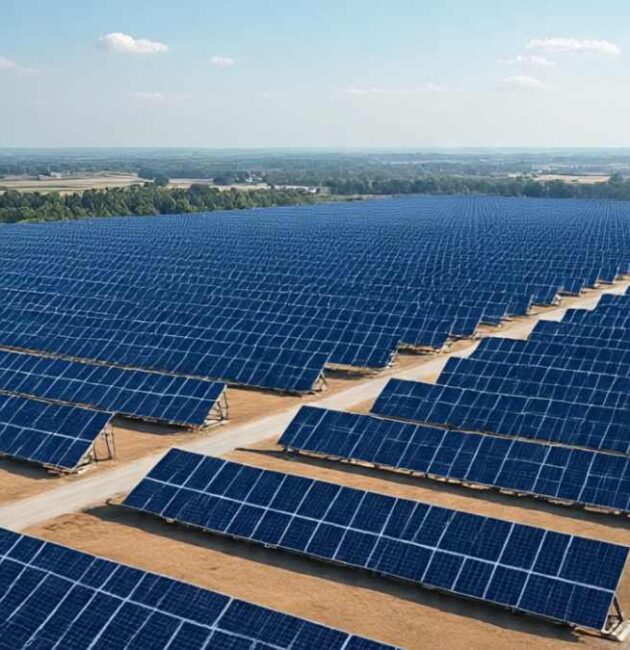
India is poised to achieve a remarkable milestone in its clean energy journey, with renewable capacity projected to increase 2.5 times over the next five years, positioning the country as the world’s second-largest growth market for renewables after China. This transformation, driven primarily by solar power installations and supported by policy reforms, signals a decisive shift in how the nation will power its future.
India’s Renewable Revolution: Breaking Records Year After Year
The International Energy Agency (IEA) has revised India’s renewable energy forecast upward by almost 10%, reflecting the nation’s accelerating momentum in clean energy deployment. This optimistic revision stems from several key developments: record auction capacity in 2024 for onshore wind and utility-scale solar PV, a rapid recovery of the onshore wind industry, the introduction of a new rooftop solar support scheme, and more efficient permitting processes for pumped-storage hydropower.
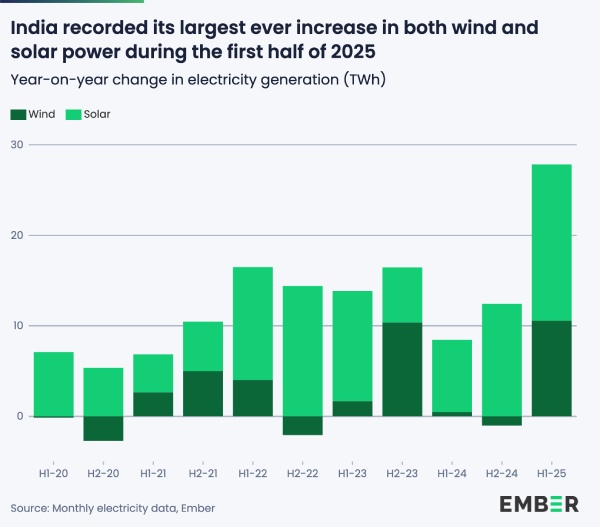
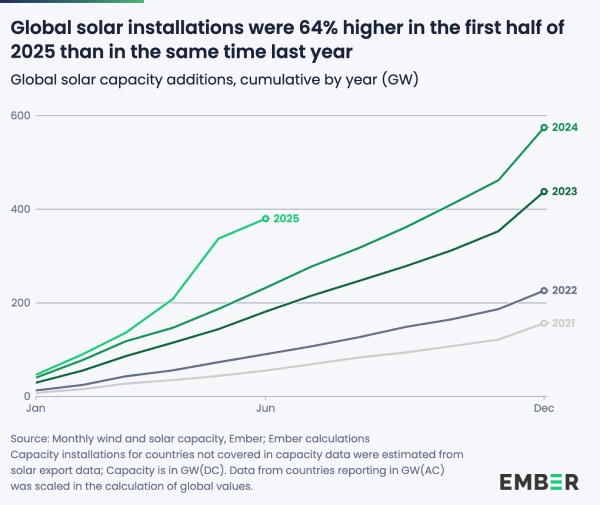
India continues to shatter its own records for solar PV installations each year, benefiting from easing supply chain challenges and a substantial pipeline of awarded capacity awaiting implementation. The country is firmly on track to meet its ambitious 2030 renewable energy targets.
Fossil Fell Year-on-Year in China and India, While the US and EU’s Rose
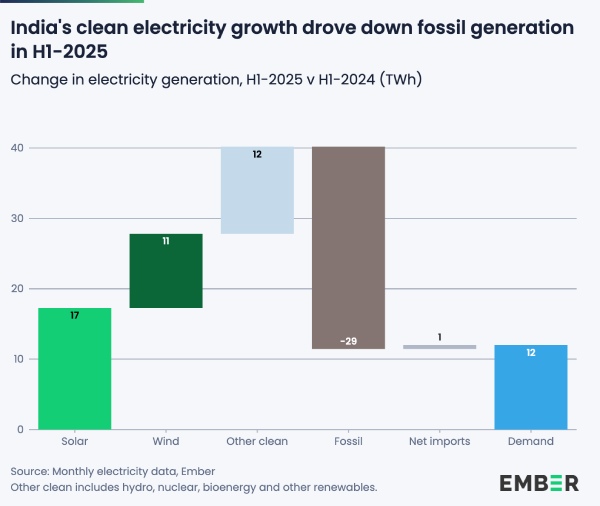
In a significant development, fossil fuel generation and related emissions fell in India during the first half of 2025, reversing trends observed in the previous year. This decline of 24 million tonnes of CO2 occurred as clean energy sources grew faster than electricity demand, demonstrating that economic growth and environmental responsibility can advance together.
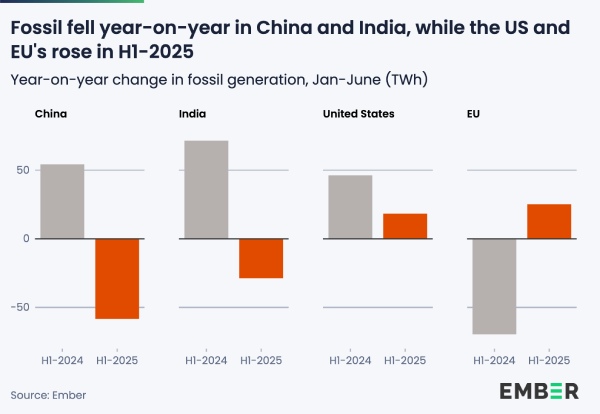
China also witnessed a decline in emissions by 46 million tonnes of CO2 during the same period. In contrast, fossil fuel generation rose in the United States and the European Union, highlighting the divergent trajectories in global power sector transitions.
India’s Clean Electricity Growth Drove Down Fossil Generation in H1-2025
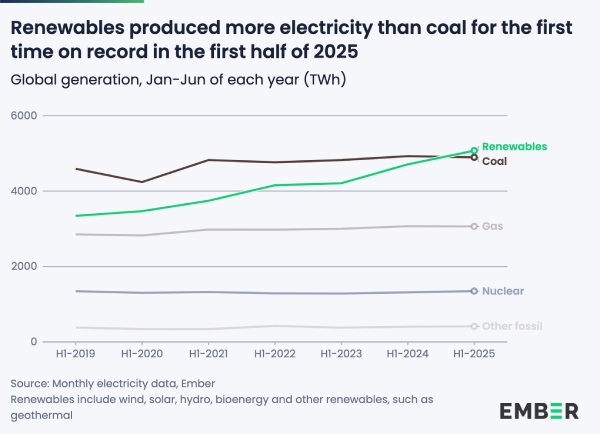
Despite global electricity demand rising by 2.6%, emissions fell slightly by 12 million tonnes of CO2 in the first half of 2025. The declines in China and India, where clean generation growth outpaced demand, were instrumental in achieving this global reduction. Solar growth was spectacular in the first half of 2025, while wind grew more moderately. Together, they met and exceeded the increase in electricity demand.
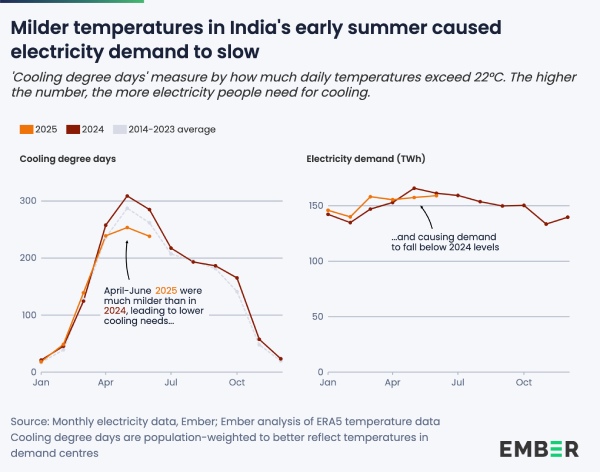
Milder Temperatures in India’s Early Summer Caused Electricity Demand to Slow
India’s electricity demand growth was relatively modest at 12 TWh (1.3%) in the first half of 2025, compared to 75 TWh (9%) in the previous year when heatwaves drove higher consumption. The milder temperatures during India’s early summer period contributed significantly to this slowdown in electricity demand growth. Despite this lower demand growth, the continued expansion of renewable capacity enabled emission reductions, underscoring the effectiveness of India’s clean energy transition.
Challenges and Opportunities: The Road Ahead
While India’s progress is commendable, several challenges require attention. Under an accelerated scenario, India’s renewable capacity growth could be 17% higher, surpassing even the ambitious 2030 targets. However, many Distribution Companies (DISCOMs) continue to face financial difficulties despite positive changes since 2022.
The geographical concentration of renewable energy generation in states like Rajasthan, Gujarat, Tamil Nadu, Maharashtra, and Karnataka necessitates greater investments in grid infrastructure and power system flexibility. Although average variable renewable energy penetration is expected to remain relatively low in 2030 due to electricity demand growth, regional concentrations will require strategic planning and investment.
Another emerging concern is the auction award rate, which dropped to 68% in 2025 after remaining stable at around 90% between 2022 and 2024. This decline suggests the need for addressing underlying factors affecting project viability and developer confidence.
Global Context: India Among the Big Four
India, along with China, the United States, and the European Union, plays a crucial role in shaping the global power sector landscape. These four nations accounted for 63% of global electricity demand and 64% of CO2 emissions in the first half of 2025. India contributed 3.3% (12 TWh) to the global demand rise during this period.
The encouraging news is that clean generation growth in India outpaced demand, contributing to a global emissions decline despite rising electricity consumption worldwide.
Solar Dominance: The Driving Force
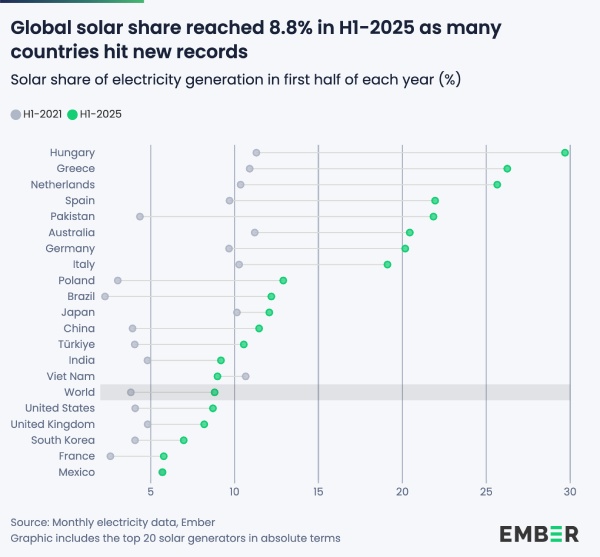
Solar power growth has been spectacular in the first half of 2025, with wind energy growing more moderately. Together, these renewable sources met and exceeded the increase in electricity demand globally. Solar PV remains the lowest-cost option for new generation in most countries, including India, ensuring its continued dominance in the renewable energy mix.
IEA Executive Director Fatih Birol emphasized the significance of this trend: “The growth in global renewable capacity in the coming years will be dominated by solar PV – but with wind, hydropower, bioenergy and geothermal all contributing, too. Solar PV is on course to account for some 80% of the increase in the world’s renewable capacity over the next five years. In addition to growth in established markets, solar is set to surge in economies such as Saudi Arabia, Pakistan and several Southeast Asian countries. As renewables’ role in electricity systems rises in many countries, policymakers need to play close attention to supply chain security and grid integration challenges.”
This is particularly relevant for India and the broader South Asian region, with Pakistan also emerging as a key growth market for solar energy alongside India’s leadership position in the region.
Beyond Electricity: Transport and Heating Sectors
While India’s renewable energy progress in the electricity sector is impressive, the role of renewables in transport and heating is expected to rise only slightly by 2030. In the transport sector, renewable energy’s share is forecast to increase from 4% today to 6% in 2030, with biofuels adding growth in India alongside other key markets like Brazil and Indonesia.
The Path Forward
India’s renewable energy trajectory demonstrates the nation’s commitment to sustainable development and climate action. With competitive auctions driving capacity additions, supportive policies enabling faster project implementation, and cost competitiveness improving continuously, India is well-positioned to achieve its clean energy ambitions.
However, success will require addressing financial challenges faced by distribution companies, investing significantly in grid infrastructure, ensuring supply chain diversification, and maintaining policy stability to sustain investor confidence. The dramatic growth in renewable capacity over the next five years will not only help India meet its climate commitments but also ensure energy security and economic competitiveness in an increasingly carbon-conscious world.